Old Still Film Processing
Step 1 — Processing and Preview of Your Pictures
Film will be processed, scanned, receive a quick digital fix-up and then be uploaded to our online shopping cart for client-preview and ordering.
| Disc Film | 18.00 / Each |
| Cassette/Roll Film | 24.00 / Each |
- If there are no detectable images on your film, there is no charge.
- Investigate what you might expect specifically from your film.
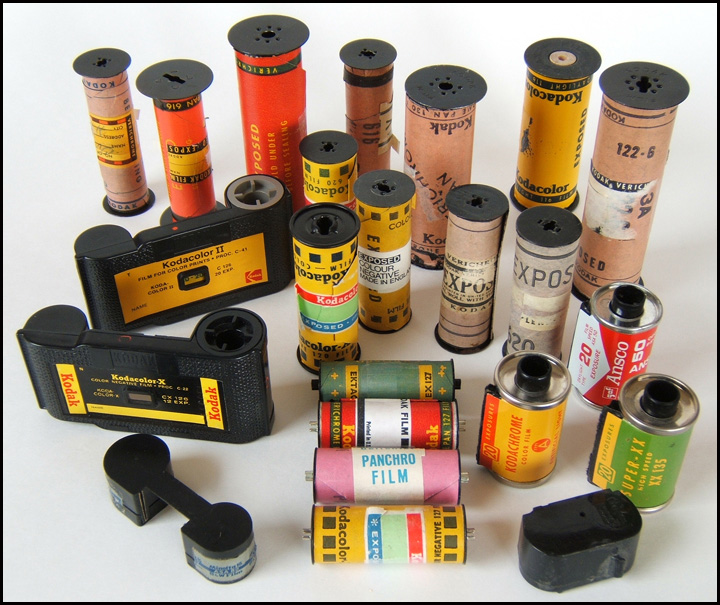
- Information on The Return of Film Spools, Cassettes and Boxes.
- Information on Process Only.
Step 2 — Ordering Pictures and Hands-on Fix-up
You select the images you want from your online preview gallery — We then do a final hands on fix-up to brightness & contrast, to reduce grain, increase sharpness and decrease spots & blemishes.
Price per image selected from our online shopping cart.
| Copy to CD or Download Image | 0.99 / Image |
| Copy to CD and Traditional Style Snapshot Print | 1.64 / Image |
Return shipping and handling
| Return Shipping & Handling (USA and Canada) | 10.00 / Order |
| Return Shipping & Handling (Outside USA and Canada) | 15.00 / Order |
| Clients Who Chose Downloads Only (Nothing Physically Returned) | No extra charge |
Take advantage of our 20% “Early Bird” discount on Copy To CD and Prints by placing your order within one week of receiving your preview.
If you would like to send us your film please fill out the order form here…
Order form
Payment
Because we don’t charge if a film is blank and because we offer on-line previews so the client is able pick and choose only the pictures they want, we have special motivation to do the best possible work. If we don’t get pictures from your film we make no money and the better the quality of the pictures we produce, the more likely a client is to place an order for those pictures. Unfortunately along with this system it is impossible to determine an end price until near the completion of an order making payment by checks highly impractical. We only take Visa or Master Card for still film processing work.
For credit card payments, your credit card number will be collected before we begin work but no charges will be placed until the completion of work.
Turn Around Time
Unlike a normal processing lab that may have one or two large volume processes under their roof we have 12 small volume processes. This creates the need to process in batches, mixing chemical and preparing for each process before moving to the next. It is not until all the film is developed that scanning begins. Once that step is complete then the digital work is done and then the uploading begins.
Film is processed in regular six week cycles. Film for the next cycle must be in our hands before the beginning of the cycle. The next cycle starts on the following date:
March 8th
Previews for undeveloped film that is in by this day should be available approximately 4 weeks later. If an order is placed after previewing your images, it should be shipped in approximately 2-4 weeks. Rush processing is available upon request. For further information on our turn-around click here.
Please don’t wait until near the beginning of a cycle to send your film. This greatly slows down our administrative process at the start of each cycle delaying work for everyone. When we can we prioritize work that arrives to us early.
Processing method
We process film in a manner most likely to give us the best quality image or to salvage an image at all.
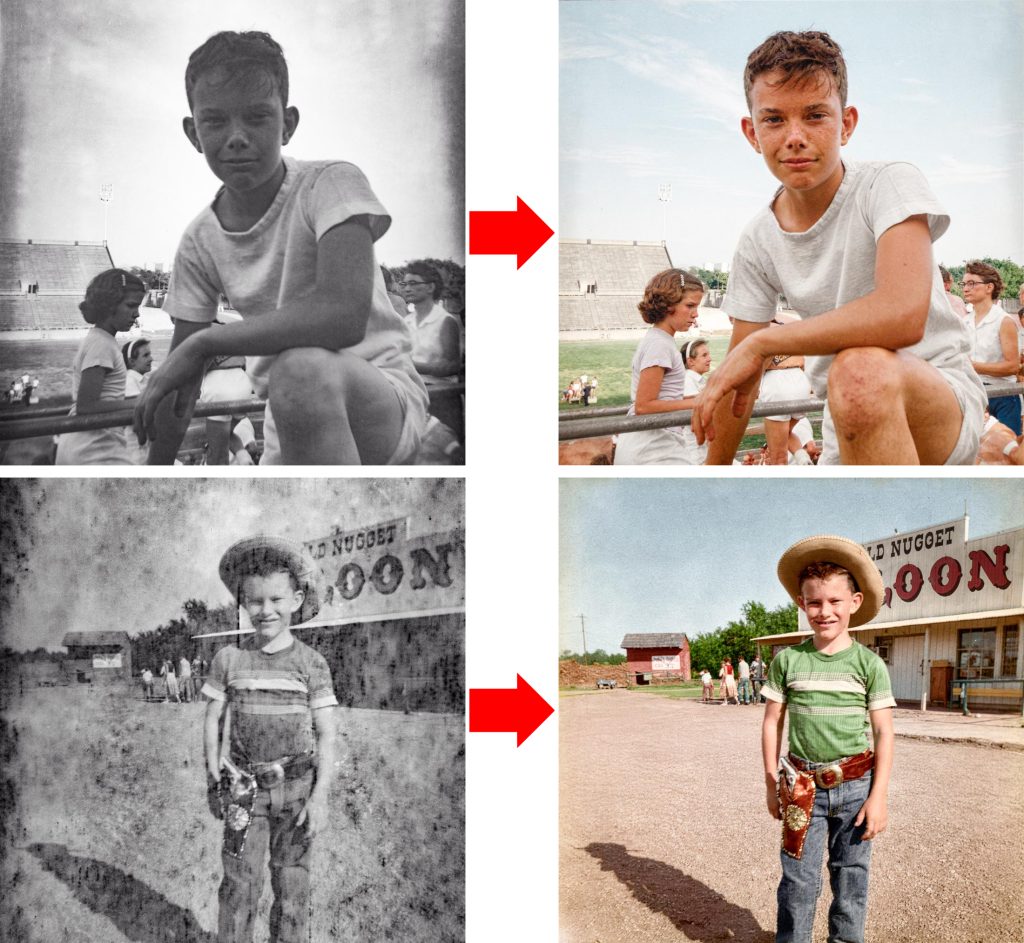
At Film Rescue International we deal primarily with people with lost and found film. People who potentially have important, never before seen, family pictures and events on their films. We process film in the manner that is most likely to salvage an image off of long expired film. Most often that is a B&W process. Two notable exceptions are Kodacolor-x roll films and Kodak Disc film. These are done by default into color because with the Kodacolor-x roll film we can eliminate a good deal of edge fogging by doing yellow light scans of color negatives and then converting them to B&W digitally. With Disc Film because the grain structure is more noticeable when processing into B&W and Disc Film negatives are tiny and require a great deal of enlargement thus causing a lot of grain…especially if processed into B&W.
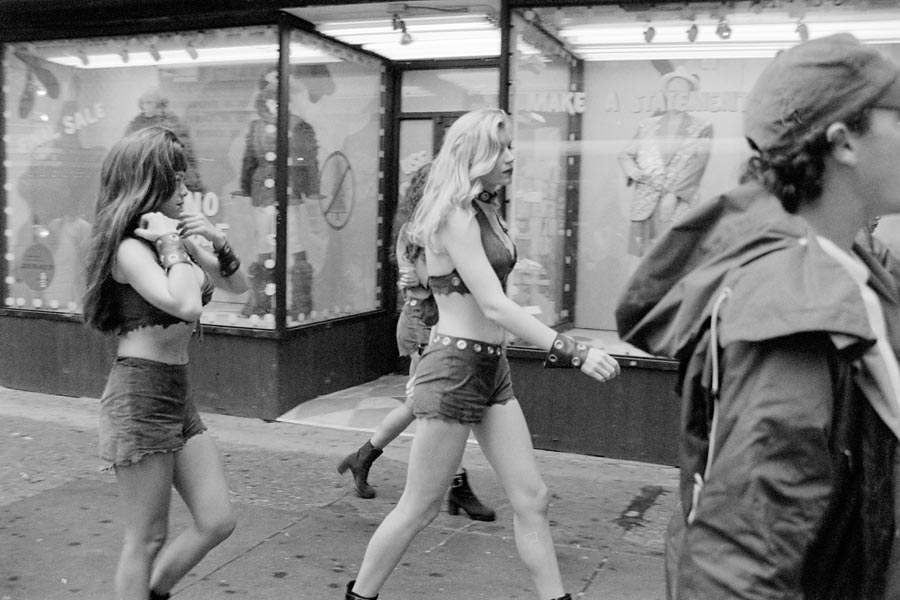
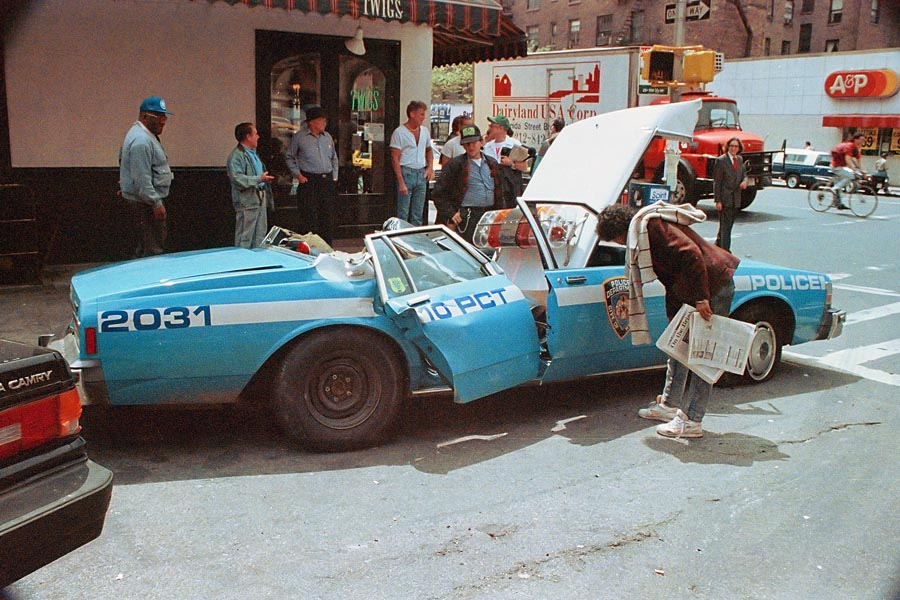
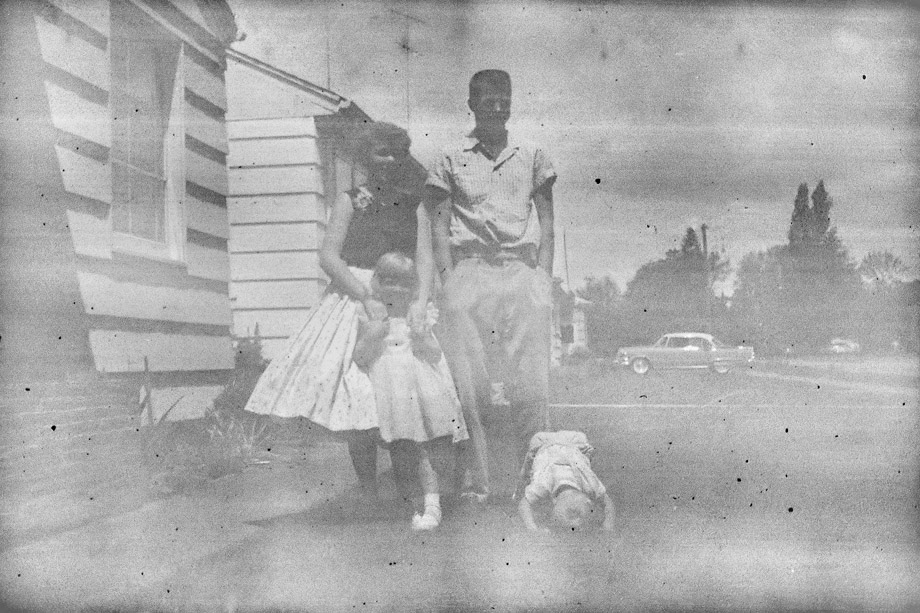
The above images are unretouched. These demonstrate why we process most color film into B&W.
This is a Kodacolor 1947 to 63 (not Kodacolor-x 1963 to 74) film bought off of E-bay, exposed by us with the identical picture through out the roll, and then cut in half to run it in different processes. The left hand image is processed in our proprietary B&W process for this film while the right hand image is processed in our best possible color process for this film. The B&W process is obviously better.
Most Films that turn out exceptionally well as B&W negatives can be and are reprocessed into color.
It is rare that the negative we salvage is good enough to make this worth while and it can only be done with color film with the exception of Kodachrome type film. Certain films such as Seattle Film Works, Kodacolor Gold, Kodak Gold, Signature film and RGB are unpredictable in terms of how well they will turn out. When we encounter a negative of exceptional quality we do a second process that turns the negative into color. This is done at no extra charge at our discrection or it can be insisted upon and the second process will be run regardless of the quality of the B&W negative, after first scanning the B&W negative for security. If you want “dual processing” regardless of the results there is an additional 20 dollars per roll fee. This will give you both B&W and color previews of your film and the option of ordering either/or. If done to our discretion there are no extra charges but will only be done with film that first turns out exceptionally well as B&W.
About our Guarantee
When we are deciding whether to scan or not scan a client’s film we are doing this upon visual inspection of the processed negative. Often times it is difficult to tell what the end quality will be without scanning and enhancing the negative. We therefore will continue with scanning and enhancing any film that we see anything on, whether that be a person, animal or object. We do not want to be put into the position of trying to make a subjective determination of what may or may not be important to a person. What is one mans trash is another’s treasure. Really terrible quality films will still be charged for – entire blank films will not. You will not be paying for absolutely nothing if your film is unexposed, improperly exposed or completely age fogged.
About our scans
Our scans result in an image that is 8 inches at 300 DPI on the short dimension or your frame. Example — a 35mm frame would be 8 x 12 inches at 300 DPI — a 110 frame would be 8 x 10 inches at 300 DPI. When you place an order for images from your gallery that we will link you to, if you choose “downloads only” upon check out, the image size is reduced to 4 inches at 240 dpi on the short dimension. This is still plenty of resolution for snap shot sized prints, on-line postings and virtually all practical applications.
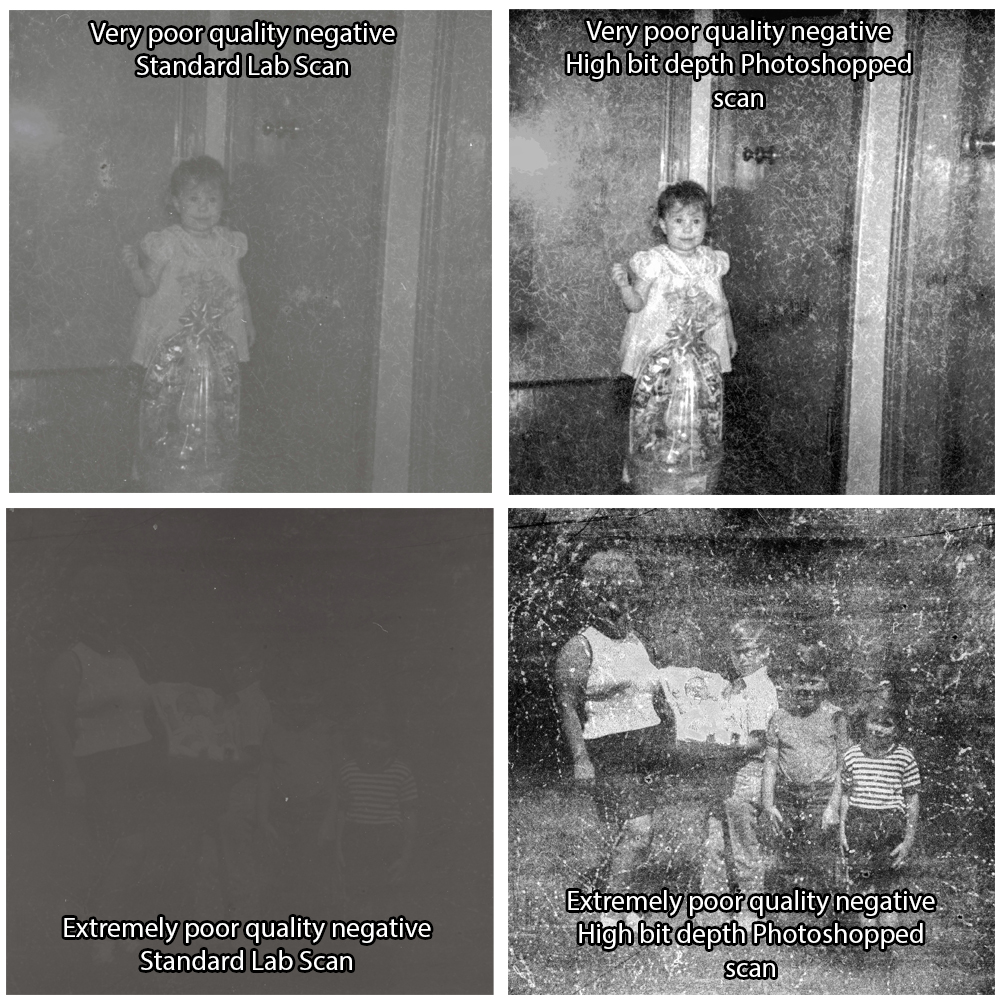
Because we are so often dealing with very low contrast negatives the scans are done at a high bit rate, then adjusted for brightness and contrast before down converting to 8 bit JPEGs. This creates a much smoother gray scale with very faded images than would be possible had the images been adjusted for brightness and contrast at 8 bit.
About our digital image repair
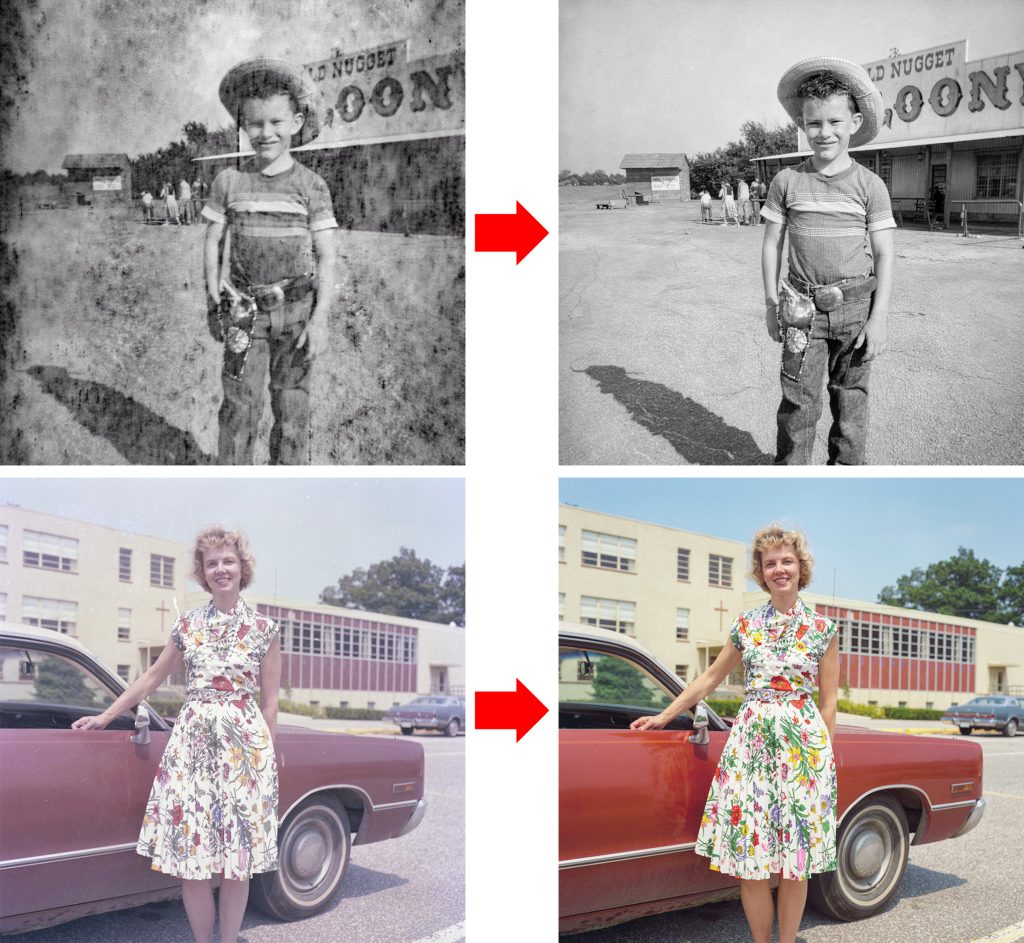
After scanning, images are given a “quick digital fix-up” which means they are adjusted for brightness and contrast. This is an automated process but it makes huge improvements on faded negatives. The point of this step is to create a presentable image for client preview without increasing the initial development and preview cost. If an image is ordered by the customer, it is brought back into “Photoshop” and manually worked by a experienced technician before giving them to you. The manipulations include…
- Brightness and contrast adjustment by eye
- Grain Reduction
- Sharpening
- De-speckling
- Edge fog reduction
- The removal of major blemishes where practical
Even with these extensive manipulations, often the “quick digital fix-up” initially performed on the film, creates an image that can be little improved. Some images are greatly improved, most are somewhat improved and others little improved with the manual fix-up. After you view your gallery you can contact us for our opinion on how much improvement may be had before you actually place an order.
About our client previews
Once we have scanned and done a quick digital fix-up to your pictures we create a gallery on our website for your images. We then send you a link via email to your gallery where you can look at your pictures. From there, you can pick and choose the pictures that you want to. It is a basic on-line shopping cart where you add the images you want to the cart and then proceed to checkout.
Please note — the preview pictures are watermarked. The watermark is removed from the ordered images.
About our prints
- Prints are optional and you choose to have prints or not when placing an order from your on-line gallery where you preview and choose your images.
- Our prints emulate the look of the past with wide borders and glossy paper. The short dimension of your image is 4 inches. Example — images from 126 film are square so the print is 4 x 4 inches – 35mm is printed onto 4 x 6 inch paper.
- Our B&W prints are done on special printers (Epson K3) designed to give high quality B&W images. Most photo finishers are printing onto light sensitive color paper. When a B&W white image is printed onto light sensitive color paper, there is a color difference between the dark parts of your picture and the light. Normally the shadows being a little green and the highlights a little magenta. Our printers eliminate this problem with consistent tone across the gray scale.
- If you have primarily color images or prefer a borderless matte print, we encourage you to simply have us make you a CD or request download and have the prints done at a reputable local service provider.
About Process only
We do offer process only for still film at a 10% discount to the above prices. However there are some things you should know:
- With some negatives that have edge fogging, the effect is greatly reduced by doing yellow light scans which required optical grade yellow filtration within the scanner.
- Some negatives after processing are as dense as welding glass and conventional scanners can not see through them.
- Some negatives have such an extremely faint image on them they can not be recognized with the preview scan on a conventional scanner making them very difficult to locate your marquee correctly during preview. Auto frame selection will not work on these negatives. Do not assume if you don’t see images upon a quick inspection, there is nothing there.
- Some films such as GAF cassettes and Triple Print blue label films are processed into an unstable reflective negative that begins fading after processing. Not only do they need to be scanned right away, they are scanned wet because the contrast on the film is much higher when wet and they can not be scanned on a normal scanner because light will not pass through them.